Silenced Intelligentsia: The Quiet Suppression of Thought.
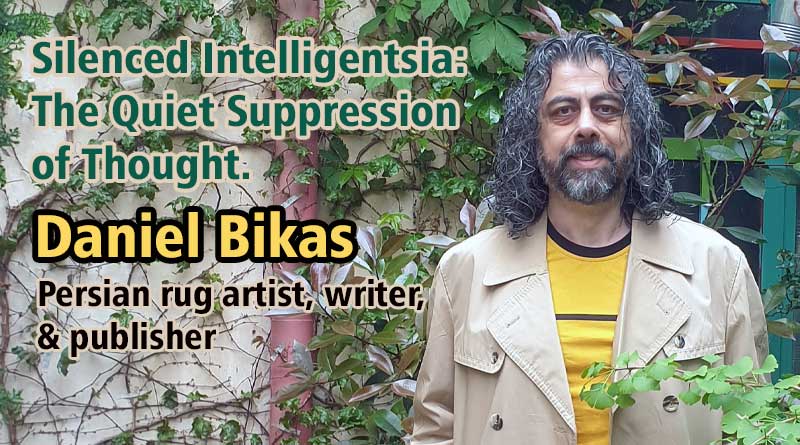
As a conceptual Persian rug artist, writer, and publisher whose work explores the intersection of art, philosophy, history, culture, and contemporary social issues. My artistic practice seeks to transform the traditional Persian handmade rug into a medium for intellectual dialogue, using symbolism and craftsmanship to address subjects that affect humanity beyond national or political boundaries.
The article “Silenced Intelligentsia” reflects this broader mission. Rather than commenting on a single country or political event, it examines the universal consequences of suppressing independent thought and creative expression. The accompanying handmade Persian silk rug serves as a visual extension of the essay, expressing the same ideas through symbolic imagery.
My perspective is shaped by years of studying history, philosophy, and social issues alongside my work as a designer and creator of conceptual Persian rugs. I believe art can encourage reflection and meaningful conversation about the challenges facing societies, while preserving the cultural heritage of one of the world’s oldest artistic traditions.
The article argues that the suppression of intellectuals—including scholars, writers, journalists, artists, and academics—is one of the greatest threats to a society’s long-term cultural, scientific, and democratic development. Throughout history, the silencing of independent thinkers has weakened public discourse, restricted innovation, and limited the free exchange of ideas. The article explores how censorship, political persecution, intimidation, and social pressure can marginalize critical voices, while emphasizing that intellectual freedom is essential for social progress, creativity, and accountability.
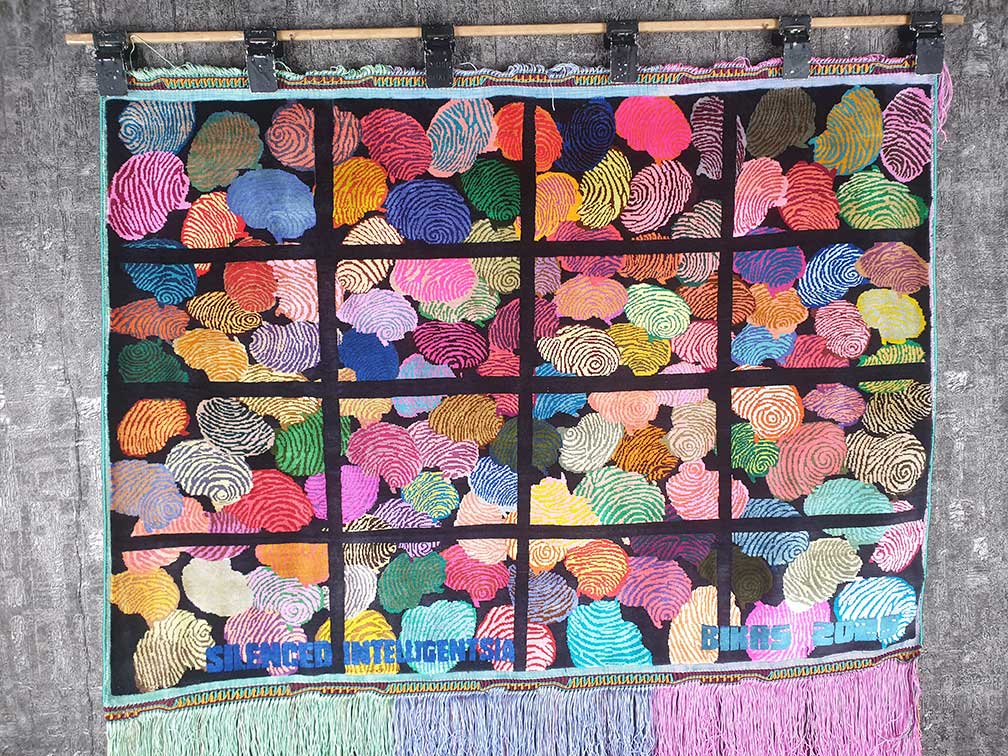
The article is accompanied by my conceptual Persian silk rug, “Silenced Intelligentsia,” which serves as a visual interpretation of the same theme. In the artwork, each figure’s brain contains a unique fingerprint symbolizing the individuality of human thought, while black bars represent censorship, repression, and the imprisonment of ideas.
Throughout history, societies have relied on their intelligentsia—scholars, writers, artists, and thinkers—to challenge norms, question authority, and inspire progress. These individuals act as society’s conscience, bringing insight, innovation, and critical perspectives to the public discourse. Yet, in many parts of the world, this vital voice has been deliberately silenced.
The silencing of the intelligentsia often occurs under authoritarian regimes, where dissent threatens centralized power. Writers are censored, academics dismissed, journalists imprisoned, and artists exiled. Such suppression is not always overt; it can be subtle, taking the form of social ostracism, blacklisting, or funding cuts, all designed to discourage independent thought. The consequence is a society deprived of reflection, critical analysis, and cultural evolution.
The effects of silencing the intelligentsia extend beyond immediate repression. Without independent thinkers, governments face less scrutiny, misinformation spreads more easily, and societal creativity stagnates. Historical examples abound: from the purges of intellectuals under Stalinist Russia, to the censorship of writers and journalists under various military dictatorships, to contemporary crackdowns in authoritarian states where even online expression is monitored.
Yet, even in silence, the spirit of the intelligentsia often persists. Underground publications, samizdat writings, and digital platforms have enabled suppressed thinkers to reach audiences despite oppression. These acts of resilience remind us that ideas cannot be completely extinguished; they can only be delayed, hidden, or reshaped.
In a globalized world, protecting intellectual freedom is crucial. Societies that value their thinkers thrive on debate, innovation, and ethical governance. Silencing the intelligentsia is not just an attack on a few voices—it is an assault on the collective mind of a nation. Recognizing, supporting, and defending these voices remains a moral imperative for any society that seeks progress, justice, and cultural vitality.
Rug Description
A full-silk wall rug (100×70 cm, KPSI: 550) that portrays the tragic beauty of a silenced intellectual class. Each figure’s head contains a distinct fingerprint, woven with microscopic precision—an unmistakable symbol of unique minds, identities, and creative signatures. These fingerprints form the interiors of their brains, representing the diversity of thought and the irreplaceable individuality of every member of the intelligentsia.
Yet all these brilliant minds stand behind stark black bars. The bars cut vertically and horizontally across the composition, creating a powerful contrast with the soft shimmer of silk and the delicate fingerprint patterns. This imprisonment of thought reflects censorship, suppression, and the forced silence of voices meant to illuminate society.
The rug’s overall aesthetic is minimalist, symbolic, and emotionally charged—an elegant but unsettling reminder of how societies lose their brightest lights when freedom of thought is confined.
Daniel Bikas
Conceptual Rug Artist
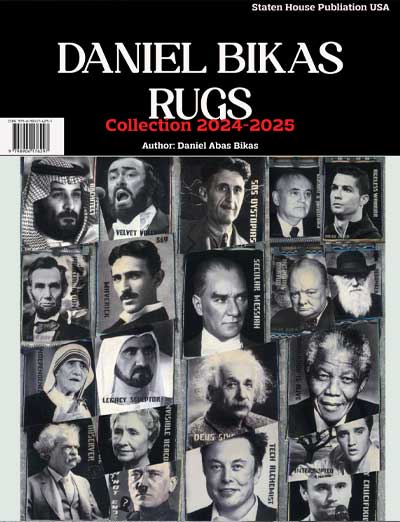
“Silenced Intelligentsia” is part of Daniel Bikas Rugs Collection 2024-2025.
- Email: bikasdaniel@gmail.com
- Phone: +98-914-400-5003
- Website: danielbikas.com
- Linkedin: Daniel Bikas
Download E-books to know more about Daniel Bikas and his unique art collections