
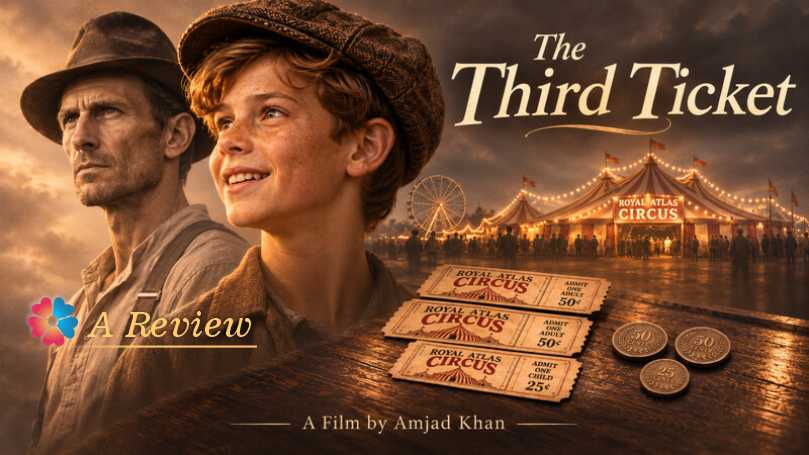
The Third Ticket: Beyond AI, A Story That Touches the Heart
Amjad Khan’s AI-generated short film takes us back to Depression-era America, weaving a touching tale of childhood, family, broken promises and the fragile emotions that can shape a young mind.
Can artificial intelligence recreate not just the appearance of human beings but also the subtle emotions, gestures and moments that make a story truly human? Indian filmmaker Amjad Khan’s AI-generated short film, The Third Ticket, offers an interesting answer to this question.
Running for approximately 18 minutes, the film takes us to Akron, Ohio, in 1937, during the Great Depression in the United States. Against a backdrop of widespread unemployment and economic hardship, it tells a simple yet emotionally engaging story of a father, his young son and a childhood dream that gradually takes an unexpected turn.
The story begins with the arrival of a traveling circus in town. A train carrying the circus animals, including elephants, lions and tigers, announces the arrival of an exciting attraction. Street announcements and advertisements create an atmosphere of anticipation, particularly among the children, who eagerly look forward to the spectacular performances.
Among them is young Eddie, who dreams of visiting the circus with his father, Thompson. However, the family’s difficult financial circumstances make even a simple outing a challenge. Thompson is struggling to find employment and repeatedly postpones his promise of taking Eddie to the circus. Eddie’s friendship with Anna, a neighbour from a considerably more well-off family, adds another interesting dimension to the story. Although the two children share a warm friendship, their contrasting family circumstances quietly reflect the economic inequalities surrounding them.
As the circus prepares for its final day in town, Eddie’s innocent expectations, his father’s helpless circumstances and a series of misunderstandings set the stage for an emotionally compelling narrative. The film gradually draws the viewer into the world of its characters, making us wonder how a seemingly ordinary childhood disappointment can lead to something far more consequential. Without revealing the rest of the story, it is worth saying that the emotional journey is what makes The Third Ticket memorable.
A World Recreated with Remarkable Attention to Detail
One of the strongest aspects of the film is Amjad Khan’s attention to visual detailing and his understanding of the environment in which the story unfolds.
Recreating 1937 America is no small creative undertaking, particularly for an Indian filmmaker working with a setting, historical period and cultural background different from his own. The film reflects considerable effort in researching and recreating the atmosphere of Depression-era Akron. The period clothing, buildings, streets and even the muddy roads during the rainy sequences help transport the audience to another time. The economic devastation and widespread unemployment of the Great Depression are not merely mentioned in the narrative; they are reflected through the surroundings and the everyday struggles of the characters.
An especially interesting example of the director’s visual storytelling is the contrasting appearance of Eddie’s and Anna’s homes. Although the two families live next door to each other, their homes tell very different stories. Eddie’s poorly maintained house reflects the financial hardship his family is experiencing, while Anna’s neat and well-kept home suggests a more comfortable lifestyle. This simple visual contrast communicates the difference between their economic circumstances without requiring lengthy explanations.
Another small but particularly impressive moment involves Thompson returning home after an unsuccessful attempt to find work. As he quietly walks past Eddie and Anna, who are sitting outside their homes, he slightly turns his head to look back at them. It is a seemingly insignificant movement, but it feels remarkably natural. Such subtle human gestures and movements can be particularly challenging to reproduce convincingly through AI-generated visuals. The way this moment has been conceived and presented reflects the director’s careful attention to character behaviour and visual expression.
These are the kinds of details that might easily go unnoticed in a conventional production, but in an AI-generated film, they deserve special appreciation. They demonstrate that successful AI filmmaking is not simply about generating attractive images; it also requires a thoughtful understanding of human behaviour and the small visual elements that make a scene believable.
Bringing the Circus to Life Through AI
The circus environment is another highlight. From the arrival of the circus train and the animals to the street advertisements and the lively atmosphere of the performances, the film creates a convincing sense of excitement. The elephants, roaring lions and tigers, along with the trapeze performances, add visual variety and help establish the spectacle that captivates the children in the story.
Creating such an elaborate environment entirely through AI requires considerable creative planning and technical effort. Amjad Khan has made a commendable attempt to bring this world to life, balancing the visual spectacle of the circus with the more intimate emotional story unfolding around it.
When AI Characters Begin to Feel Human
Perhaps the most interesting aspect of watching The Third Ticket is the way its AI-generated characters communicate human emotions.
In a conventional film review, we naturally discuss the acting performances, facial expressions, body language and screen presence of the actors. But reviewing an entirely AI-generated film presents an unusual situation. We find ourselves appreciating the characters’ performances, even though no conventional actors actually performed these roles in front of a camera!
The characters appear convincingly human, and their gestures and expressions encourage us to respond to them as we would to real actors. Yet, what we are actually appreciating is the director’s creative vision and the technical team’s ability to translate human emotions into digital characters. It is an interesting new dimension of filmmaking that makes reviewing AI cinema an experience in itself.
Of course, a few sequences do reveal the limitations of AI-generated visuals. Certain movements or visual details occasionally make the artificial nature of the production noticeable. However, these minor inconsistencies do not significantly affect the overall viewing experience. More importantly, they do not interrupt the emotional continuity of the story.
The narrative continues to hold the viewer’s attention, and the emotional connection with the characters remains intact. In this respect, Amjad Khan has made a commendable effort to narrow the gap between conventional filmmaking and entirely AI-generated cinema. The film demonstrates that while visual perfection remains a challenge, a compelling story and a thoughtful directorial approach can successfully overcome many of the technology’s present limitations.
A Human Story Beyond the Technology
Ultimately, the strength of The Third Ticket lies in its ability to keep human emotions at the centre of an AI-generated production. Beneath its technological achievement is a simple, relatable story about childhood innocence, parental helplessness, broken promises and misunderstandings. It reminds us that children often perceive situations very differently from adults, and that moments which may seem insignificant to grown-ups can leave a lasting impression on young minds.

For Amjad Khan, the film is also a creative interpretation of a real-life incident shared by an acquaintance, who had left home as a child to travel with a circus and was reunited with his family many years later. Although the film’s characters and events are fictional, this unusual real-life inspiration gives the narrative an additional layer of interest
For Amjad Khan, the film is also a creative interpretation of a real-life incident shared by an acquaintance, who had left home as a child to travel with a circus and was reunited with his family many years later. Although the film’s characters and events are fictional, this unusual real-life inspiration gives the narrative an additional layer of interest.
Amjad Khan brings more than two decades of professional storytelling experience to his filmmaking journey. His earlier film, Egg War, was selected for the AI Film Showcase at the WAVES Pavilion during the India AI Impact Summit 2026, in collaboration with the Ministry of Information and Broadcasting and NFDC. His screenwriting journey also includes recognition at the Jaipur International Film Festival in 2022, along with creative associations with established filmmakers and industry professionals.
With The Third Ticket, he demonstrates an understanding that technology alone cannot make a film meaningful. It is the thought behind the story, the attention to detail and the ability to evoke emotions that ultimately matter.
On behalf of Lifeplus Magazine and our readers, we extend our warm wishes to Amjad Khan and the entire creative and technical team behind The Third Ticket. Their effort to explore the possibilities of AI filmmaking while keeping human emotions at the heart of the story is truly commendable. We look forward to seeing many more creative and inspiring works from the director and his team in the future.